Showing posts with label museum. Show all posts

Sunday, November 22, 2020

CELEBRATION OF LIGHT

troy historic village

We jump started the holiday season with a visit to the Troy Historical Village's CELEBRATION OF LIGHT exhibit. This museum in Troy, Michigan preserves buildings that were in use within the community from the 1800s - 1920s laid out around a town square letting people step back into time to experience what life was like when the suburban city was instead a rural farming community. The village includes a log cabin, black smith shop, mercantile building, church with parsonage, one room school house and a Civil War era home. All lit up with holiday flair after dark this time of year.

Due to the pandemic my kids have been doing virtual learning from home so far this school year. This outing made for a nice home schooling field trip. We learned a lesson on the origination of candles in celebrating birthdays during our stop at the Troy Historic Village's school house. An interesting topic for my twins whose birthday is during the holiday season between Christmas and New Year's Day.

troy historic village

Each of the buildings along a designated socially-distanced path provide interesting tidbits about how light is incorporated into secular and religious celebrations as nights get darker and the year end approaches. Learn about how civilization mastered light and expanded beyond a practical need to also provide spiritual and symbolic significance. In addition to some colorful displays visitors can also learn interesting trivia making a visit to the Troy Historical Village both an entertaining and educational experience.

troy historic village

troy historic village

Viewing the Village in a different light by visiting after dark, this event embraces the rich diversity of the city's population providing a chance for neighbors to take a look at different perspectives from a variety of cultural groups that call Troy home. Jewish, Hindu, Muslim and Christian traditions are reflected in displays that share the ways light is used in their faith and cultures in daily observances and annual celebrations.

troy historic village

troy historic village

troy historic village

Head over to troyhistoricvillage.org for more information about this CELEBRATION OF LIGHT. The Troy Historic Village is located at 60 W. Wattles Road in Troy, Michigan. With so many holiday activities cancelled this is a nice way to spend a festive evening. I've always though history is fun and events like this are a nice way to showcase that attitude and enjoy some holiday cheer.

Saturday, February 1, 2020

VALENTINES FOR VETS

military museum
We rolled up our sleeves to help some Rosie the Riveters in crafting Valentines for veterans. The Eastern Michigan Women Ordnance Workers chapter of the American Rosie the Riveter Association held the event which included some of the actual ladies who worked on wartime assembly lines producing airplanes, tanks, and other military equipment during World War II.  Anyone was welcome to stop into the Michigan Military Technical & Historical Society museum to join in making some handcrafted Valentine's Day cards to be distributed by WOW members at the Vets Returning Home Center in Roseville, Michigan.

My daughter met a number of actual "Rosie the Riveters" who had taken over gritty manufacturing jobs previously held exclusively by men prior to WWII as they supported the war effort providing the Asian and European military theaters with supplies for Allied troops fighting the Axis alliance. We took some pictures with 92 year old Mary who worked on an assembly line helping put together B-26 bomber aircraft at a plant in Detroit.

girldad


Rosie the Riveter has become an iconic feminist symbol highlighting the contributions women made during World War II in providing the muscle of America's arsenal of democracy in manufacturing facilities across the country. The term first originated in a 1943 song by Redd Evans titled "Rosie the Riveter"

All the day long, whether rain or shine She's a part of the assembly line She's making history, working for victory-- Rosie, brrrrrr, the riveter. 

Keeps a sharp lookout for sabotage Sitting up there on the fuselage. That little frail can do more than a male can do-- Rosie, brrrrrr, the riveter.

Rosie's got a boyfriend, Charlie. 

Charlie, he's a Marine. 

Rosie is protecting Charlie, workin' overtime on the riveting machine. 

When they gave her a production "E," she was as proud as a girl could be! 

There's something true about--red, white, and blue about--Rosie, brrrr, the riveter.

Based upon the popularity of the song, posters depicting "Rosie the Riveter" were used by the Canadian and United States governments to promote civilian initiatives and moral during World War II. It is believed the look of Rosie was based upon a woman named Rose Will Monroe who worked as a riveter in the Willow Run Aircraft Factory building B-24 bomber planes. She was featured in a promotional film about the war effort at home that was playing in movie theaters around the same time Evans song was becoming a national hit. The two coincided to create the classic image of Rosie the Riveter that has become a national symbol of equality and patriotism.

poster


Rosie the Riveter wasn't just a symbol though. There were millions of real life Rosie the Riveters who were in their teens, twenties and thirties during World War II with the ones who are still with us now in their eighties, nineties, and some are over a hundred years old. Many of these elderly women are still helping the soldiers participating in WOW chapters doing activities such as making holiday cards for veterans and preparing care packages for active duty troops overseas. Plus they make an effort to continue to keep the memory of Rosie the Riveter alive with new generations of girls like my own daughter. It was a great experience to spend some time with a few of these real life Rosie the Riveters.

Meant to preserve and promote the history of the Arsenal of Democracy, the Michigan Military Technical and Historical Society incorporates WOW chapter events into the programming at its Eastpointe museum. The Michigan Military Technical and Historical Society museum houses a variety of exhibits in its 11,000 square foot museum that showcase locally manufactured equipment, uniforms, weapons and vehicles utilized by the United States armed forces from World War I through the present day. This volunteer-driven museum is located at 16600 Stephens Road, Eastpointe Michigan 48021 and is open on weekends. Saturdays 10 am - 5pm + Sundays Noon to 4pm. For more information, go to mimths.org

Saturday, July 23, 2016

Intrepid Sea, Air & Space Museum

While in New York City for the annual Blogger Bash conference, which provides an opportunity for bloggers to network with and learn about some amazing brands, I found some time to explore the Intrepid Sea, Air & Space Museum.  Located in Manhattan's Hell's Kitchen neighborhood (the stomping grounds of one of my favorite Marvel Comics characters Daredevil) at Pier 86 along the Hudson River, this unique museum allows visitors to examine a decommissioned aircraft carrier, space shuttle, submarine and a variety of historic aircraft including the record-breaking British Airways Concorde.  The Intrepid Sea, Air and Space Museum is open April through October weekdays 10 am - 5 pm and on the weekends 10am - 6pm.  During the rest of the year it is open daily throughout the week 10 am - 5 pm.

The main attraction of the museum is the World War II era USS Intrepid aircraft carrier, which is a National Historic Landmark.  This aircraft carrier survived five kamikaze attacks and one torpedo strike during World War II and played an important role in the Vietnam War.  The vessel also served as a NASA recovery vessel for space capsules returning to Earth before it was decommissioned in 1974.  Intrepid can now be toured providing a glimpse at what life was like on a mid-twentieth century navel vessel and displays a variety of civilian and military aircraft on the flight deck and within its giant interior hanger.


There are some amazing views from the decks of the Intrepid and a visit will bring out your adventurous spirit as you explore the ship's interior.  Be prepared there are some steep ladders and walkways to traverse but making the effort to visit the various nooks and crannies of the aircraft carrier is well worth the effort.


At the back of the aircraft carrier's flight deck is the Space Shuttle Pavilion.  This houses the space shuttle Enterprise, which was the prototype NASA orbiter which was used for flight tests to help design the shuttle fleet that went into space.  As this shuttle never went into space and was used for testing descent within the planet's atmosphere it is essentially gutted with nothing to view inside.  Yet it is still impressive to be able to walk directly underneath the first space shuttle are get a dynamic view of it from an elevated platform.  Also on display is a Russian Soyuz TMA-6 rocket capsule which provides an interesting comparison on two different approaches to traveling into outer space.


My grandfather was a submariner during the same era the USS Intrepid was in service, including 9 patrols in the South Pacific during WWII, and I was always fascinated to hear him tell stories of his tours of duty at sea.  So I really enjoyed the opportunity to walk through a ship similar to the ones he captained in the later years of his career during my visit to the museum.  You are able to walk through the USS Growler, one of America's first guided missile submarines, providing a firsthand look at a crew's life aboard one.  A tour of the Growler also provides you with an appreciation of how much technology has advanced since this ship prowled the seas in the 1950s and '60s when you take a look at the equipment in the "top secret" missile command center.  I really give a lot of credit to the crews who do tours on the confined spaces of today's modern submarines and this tour really puts into perspective the tough living conditions on early submarines that make being assigned to this duty in modern times appear almost to be a luxury in comparison.  Walking through the Growler is a pretty eye opening experience and not something you want to do if you are claustrophobic.


Also on display is British Airway's Concorde which set a record for the fastest flight crossing the Atlantic Ocean on February 7, 1996 at 2 hours, 52 minutes, and 59 seconds.


With so many fascinating things to take in at the Intrepid Sea, Air & Space Museum you should plan on spending at least a half day exploring the place.  In addition to the vessels and vehicles being shown there are all sorts of interesting films and exhibits to view while you visit.  I really had a great time checking out the museum and would highly recommend you make an effort to visit it during a trip to New York City.


For more information, visit intrepidmuseum.org


Friday, February 26, 2016

CROCS - ANCIENT PREDATORS IN A MODERN WORLD

Crocs
(c) ageekdaddy.com - All Rights Reserved
During a recent family road trip to Washington D.C., we stopped by the National Geographic Museum to check out their newest exhibit CROCS - ANCIENT PREDATORS IN A MODERN WORLD.  A stop by the reptile house on any visit is a must do for my kids so when I heard that National Geographic was featuring an exhibit on crocodiles our family had to go see it while we were in town.  We weren't disappointed as CROCS lets visitors sink their teeth into the history, biology and behaviors of this fascinating species through fossils, models and actual real life animals.

Crocodiles were roaming the Earth munching on dinosaurs for snacks more than 100 million years ago.  While the dinosaurs became extinct, these predatory reptiles were able to to adapt and survive to modern times.  While much smaller in size now, today's alligators and crocodiles still very much resemble their prehistoric predecessors just in more miniaturized forms.  While not as large as their prehistoric ancestors these predators are still very formidable.  An average adult male American alligator is 11 feet long and they can weigh up to 1,000 pounds.  Salt water crocodiles can get even larger being able to grow to more than 17 feet long and weigh up to 3,000 pounds.  These magnificent creatures can be very deadly so if wandering in their natural habitat you shouldn't take dealing with them lightly.

National Geographic Museum
(c) ageekdaddy.com - All Rights Reserved

 While there are plenty of informative placards on display throughout the exhibit, it also a very nice digital component to it.  Videos of Dr. Kent Vliet, the primary scientific advisor for the project, as well as other crocodilian experts, appear as a running thread as visitors walk through the exhibit.  There are also hands-on interactive activities to experience.  Listen to croc calls then hear what a scientist believes what you just heard means.  Create a 3D animation of an extinct crocodilian  or test your strength against a croc on a modified force gauge that demonstrates how researchers measure the strength of real crocodile bites.  If you want to do something a bit less strenuous test your crocodilian IQ with fun facts and croc trivia.

There are several dioramas on display depicting realistic models of various types of crocodilians in their native habitats.

National Geographic
(c) ageekdaddy.com - All Rights Reserved
Crocs
(c) ageekdaddy.com - All Rights Reserved


My son was amazed by the life-sized model of Gomek, one of the world's largest crocodiles to ever be held in captivity.  When he died at Florida's St. Augustine Alligator Farm Zoological Park in1997, Gomek was nearly 18 feet long and weighed 1,896 pounds. That was one big croc!

Crocs
(c) ageekdaddy.com - All Rights Reserved

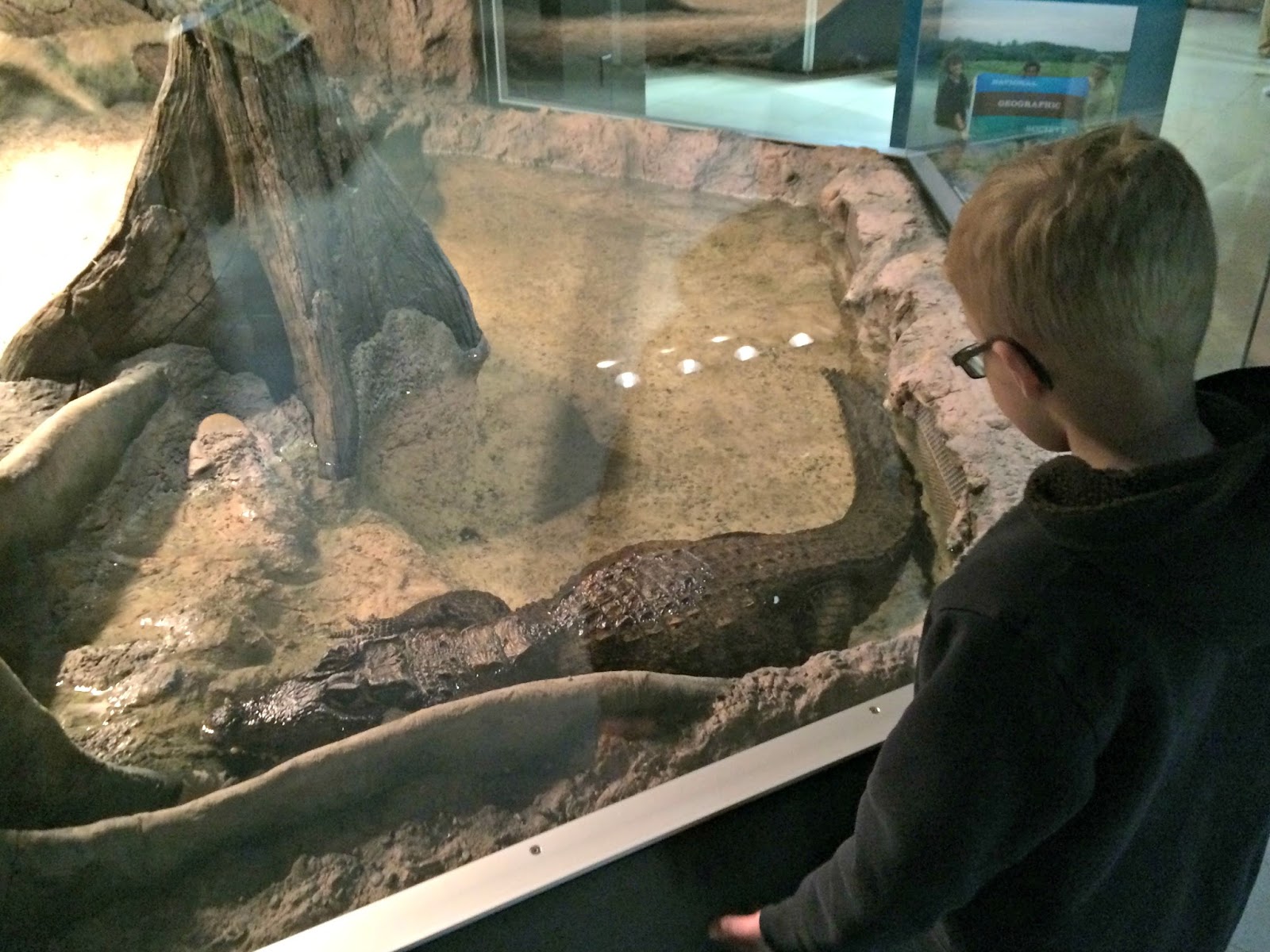
The hit of our visit though was seeing the several dioramas on display featuring live crocodilians that ranged from very small to somewhat large in size.  The exhibit actually let you get fairly close to the animals for some terrific views.


CROCS will be at the National Geographic Museum until May 8, 2016 when it will be rotated out for a new exhibition.  Admission is $15 for adults, $12 for Magazine Subscribers, Military, Seniors (62+), College & High School Students and $10 for Children ( 5-12 years old).  The museum is open 7 days per week from 10 am - 6pm.  It is closed two days per year, Thanksgiving & Christmas Day.

Included with our admission to CROCS was a walk through the PHOTO ARK.  Photographer Joel Sartore has compiled a gallery of portraits of endangered species with the goal of encouraging people to care about conservation and habitat preservation.  These are some stunning photos and it is really troubling that some of these creatures will no longer be alive on our planet within the next decade.


Of course we couldn't leave without a souvenir! Check out this unique personalized National Geographic Magazine cover we created on our way out. The kids picked out the cheetah theme because that is my son's favorite animal.  What a nice memory keepsake to remember our visit to the National Geographic Museum.

Crocs
(c) ageekdaddy.com - All Rights Reserved
Crocs
(c) ageekdaddy.com - All Rights Reserved

Tuesday, January 26, 2016

Our family outing to The Henry Ford

During Michigan winters you can easily go stir crazy by not getting out of the house to do some sort of activity, especially when you have two rambunctious seven year old children to contend with.  We recently spent one cold January day exploring the huge indoor museum at The Henry Ford.  This educational institution's complex in the Detroit suburb of Dearborn, Michigan consists of the outdoor Greenfield Village that is made up of original and replica structures from days gone by (which is closed for the winter) and the indoor Henry Ford Museum which preserves items relevant to American history and its industrial heritage.  The museum was founded with automobile manufacturer Henry Ford's personal collection of Americana and has continued to expand ever since it opened in 1933 serving as an archive that preserves elements of our nation's past and works to inspire future generations in building the future.  It is a huge building to explore that provides an educational and entertaining experience for both children and adults.  Whether you are visiting from out of town or a lifelong resident of the area, you'd be negligent not to check out the Henry Ford Museum if you are looking for something to do on a chilly winter day in Southeastern Michigan.

Hey the building is so big it can house an Allegheny locomotive! Designed for pulling huge coal trains over the Allegheny mountains of West Virginia this locomotive on display was built in 1941 and weighed 600 tons making it one of the largest steam-powered locomotives ever built.  Climb up in the cab of the locomotive and imagine you are the engineer driving this behemoth down the tracks.


They also have a display of planes showcasing the accomplishments of pioneering aviators.  Check out a replica of the Wright Flyer, sit in the passenger seats of an early commercial airplane, or participate in a simulation of being an acrobatic bi-plane wing walker.


This museum also pays tribute to the industrial heritage of the country including the mechanization of agriculture, gigantic multi-story examples of early steam engines that were used for mines, mills, factories and power plants, and a reproduction of Ford Motor Company's first automotive assembly line.  The Henry Ford has even partnered with Ford Motor Company to provide a tour experience of the car manufacturer's Rouge Assembly Plant where today's F-150 trucks are built busing participants from the museum to this off-site facility.  My kids had fun pretending to drive a combine in the agricultural tools section.


Of course with a museum named after Henry Ford you know they have to have some cars on display.  They have a huge display of early vehicles plus advertising and other items that tell the story of how automobiles have shaped American culture.  I love neon lights - this working McDonald's drive-in sign exhibited at the Henry Ford Museum is amazing!


I'm a fan of NHRA Drag racing so seeing some of the earliest cars designed for racing, including the "Rocket" was very interesting for me.


They even have one of the original the Oscar Mayer Wienermobiles!


Combining automotive and political history, the museum has on display several presidential limousines.  These include the horse-drawn Brougham carriage used by Theodore Roosevelt, the "Bubbletop" limo used by Presidents Truman and Eisenhower, Franklin Roosevelt's "Sunshine Special" and the vehicle President Reagan was rushed to the hospital in after being shot in an assassination attempt.  The Reagan limousine is the last presidential vehicle allowed to be preserved and displayed.  All limousines since that time period are destroyed by the Secret Service for security reasons when they are removed from use within the presidential motorcade.  On a somber note the actual presidential limousine that John F. Kennedy was riding in when he was assassinated is also on display at The Henry Ford.


Other historic artifacts on display at the museum include an original Thomas Paine "Common Sense" Revolutionary War era propaganda pamphlet, one of the few surviving copies of the Declaration of Independence, the cot George Washington slept in while traveling with the Continental Army, and the actual chair Abraham Lincoln was shot in when he was assassinated at Ford Theater (no relationship to the Ford automobile family).


My daughter even had the chance to sit in the very seat that Rosa Parks refused to give up to a white man in civil disobedience of Southern segregation laws.  A nice lesson that no one should be bullied or prejudiced against because of things like race, sexuality, or religious affiliation.  That Montgomery, Alabama bus that Rosa Parks was riding on December 1, 1955 when she was arrested for refusing to be discriminated against has been restored and is on permanent exhibit.


Understanding that the attention span of children may wane as they wander through the museum, The Henry Ford has taken incorporated a few activities to cater to its younger visitors.  Kids visiting on a family outing will be amused by spinning a wheel as fast as they can to see how many lights they can power at once with their kinetic energy, build whatever creations they can imagine out of LEGO DUPLO toys in a designated building zone, viewing a huge model train exhibit that is at their eye level, and using a green screen to include themselves in classic 1980's MTV music videos, among other things.


I've referred to just a few of the discoveries you can make while exploring The Henry Ford's indoor museum.  To really appreciate the Henry Ford Museum though you can't just read about the place on an online post but rather need to pay it a visit where you can stroll through this repository of Americana to take it all in.


For more information including hours the museum is open to the public and directions to get there, visit thehenryford.org