
 |
| (c) ageekdaddy.com - All Rights Reserved |
Crocodiles were roaming the Earth munching on dinosaurs for snacks more than 100 million years ago. While the dinosaurs became extinct, these predatory reptiles were able to to adapt and survive to modern times. While much smaller in size now, today's alligators and crocodiles still very much resemble their prehistoric predecessors just in more miniaturized forms. While not as large as their prehistoric ancestors these predators are still very formidable. An average adult male American alligator is 11 feet long and they can weigh up to 1,000 pounds. Salt water crocodiles can get even larger being able to grow to more than 17 feet long and weigh up to 3,000 pounds. These magnificent creatures can be very deadly so if wandering in their natural habitat you shouldn't take dealing with them lightly.
 |
| (c) ageekdaddy.com - All Rights Reserved |
While there are plenty of informative placards on display throughout the exhibit, it also a very nice digital component to it. Videos of Dr. Kent Vliet, the primary scientific advisor for the project, as well as other crocodilian experts, appear as a running thread as visitors walk through the exhibit. There are also hands-on interactive activities to experience. Listen to croc calls then hear what a scientist believes what you just heard means. Create a 3D animation of an extinct crocodilian or test your strength against a croc on a modified force gauge that demonstrates how researchers measure the strength of real crocodile bites. If you want to do something a bit less strenuous test your crocodilian IQ with fun facts and croc trivia.
There are several dioramas on display depicting realistic models of various types of crocodilians in their native habitats.
 |
| (c) ageekdaddy.com - All Rights Reserved |
 |
| (c) ageekdaddy.com - All Rights Reserved |
My son was amazed by the life-sized model of Gomek, one of the world's largest crocodiles to ever be held in captivity. When he died at Florida's St. Augustine Alligator Farm Zoological Park in1997, Gomek was nearly 18 feet long and weighed 1,896 pounds. That was one big croc!
 |
| (c) ageekdaddy.com - All Rights Reserved |
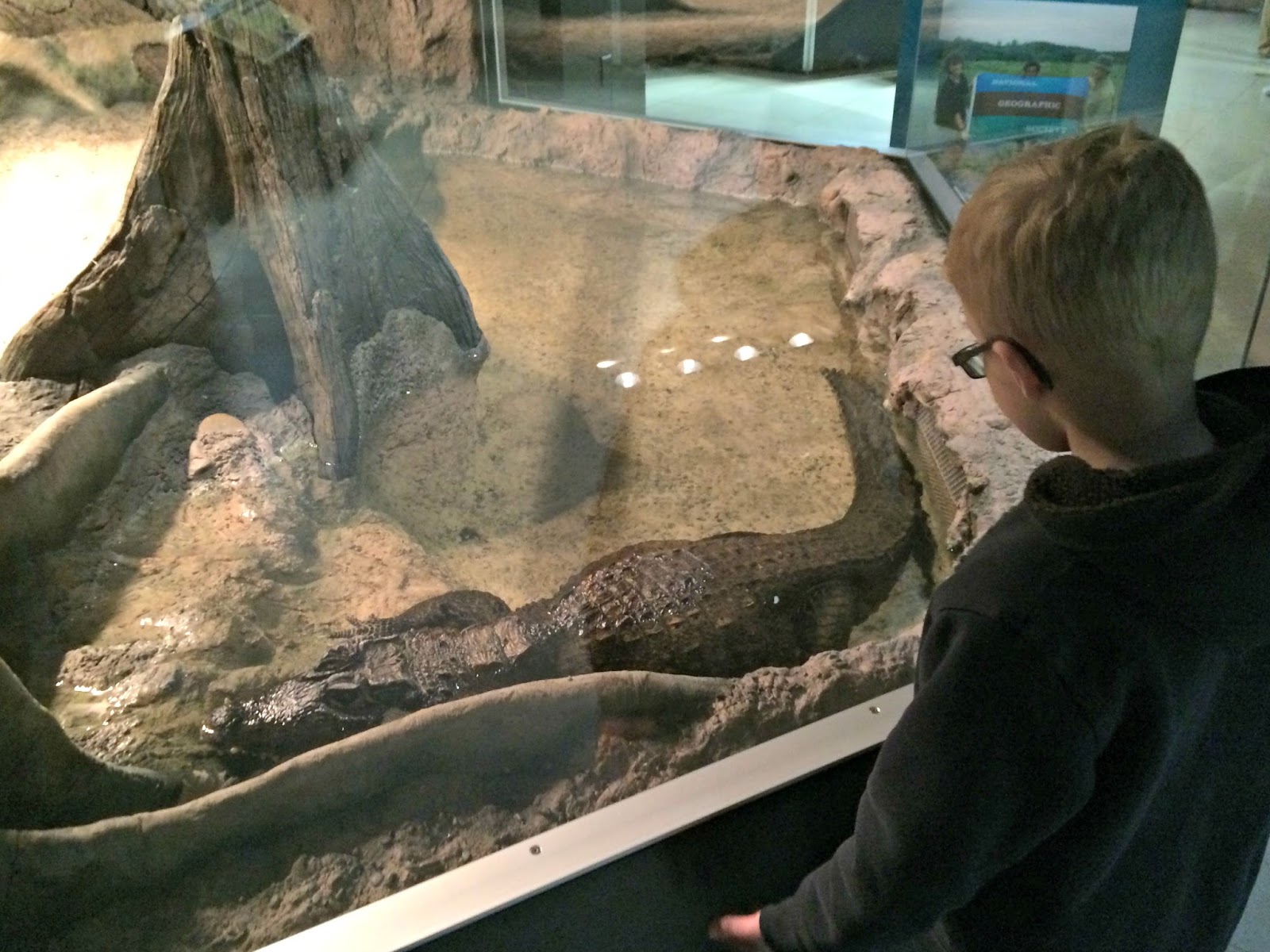
The hit of our visit though was seeing the several dioramas on display featuring live crocodilians that ranged from very small to somewhat large in size. The exhibit actually let you get fairly close to the animals for some terrific views.



CROCS will be at the National Geographic Museum until May 8, 2016 when it will be rotated out for a new exhibition. Admission is $15 for adults, $12 for Magazine Subscribers, Military, Seniors (62+), College & High School Students and $10 for Children ( 5-12 years old). The museum is open 7 days per week from 10 am - 6pm. It is closed two days per year, Thanksgiving & Christmas Day.
Included with our admission to CROCS was a walk through the PHOTO ARK. Photographer Joel Sartore has compiled a gallery of portraits of endangered species with the goal of encouraging people to care about conservation and habitat preservation. These are some stunning photos and it is really troubling that some of these creatures will no longer be alive on our planet within the next decade.

Of course we couldn't leave without a souvenir! Check out this unique personalized National Geographic Magazine cover we created on our way out. The kids picked out the cheetah theme because that is my son's favorite animal. What a nice memory keepsake to remember our visit to the National Geographic Museum.
 |
| (c) ageekdaddy.com - All Rights Reserved |
 |
| (c) ageekdaddy.com - All Rights Reserved |


