One of my favorite all-time science fiction television shows is coming to COMET TV in April of 2017. The television channel which broadcasts horror and science fiction genre programming that can be received by digital antennas in select markets and is streamed on their website comettv.comwill begin showing reruns of Stargate SG-1 episodes beginning on Monday, April 4 at 8pm ET. Tune in to catch the galaxy exploring exploits of the SG-1 team.
Stargate SG-1 picks up the story from the conclusion of the 1994 STARGATE motion picture. The television show follows the adventures of a military team called SG-1 and other counterpart SG teams as they explore the galaxy by traveling to distant planets through worm-hole portals generated by a device called the Stargate. During their travels they make new friends and foes which lead to a variety of adventures and conflicts. The series was shown on Showtime from 1997 - 2002 and on the SyFy cable channel from 2002 - 2007. Throughout the show's 10 season run it was was also syndicated on Fox television stations across the United States.
Comet TV will also be airing two Stargate television specials beginning on Saturday, March 17 to celebrate the show coming to their channel. "Behind the Mythology of Stargate SG-1" will be airing at Midnight/11 C and "Stargate SG-1: True Science" will be shown at 1 am ET/ Midnight Central Time. These specials look into the historical and scientific aspects of the television series featuring cast and experts in the areas discussed.
"Behind the Mythology of Stargate SG-1" hosted by actor Michael Shanks who plays archeologist Daniel Jackson in the television series delves into how many of Earth's mythologies are intertwined with the plots and characters of Stargate SG-1.
"Stargate SG-1: True Science" hosted by actress Amanda Tapping who plays the team's science officer Samantha Carter in the television series explores the real life science that is relevant to the technology displayed within the Stargate universe. Tapping discusses with scientists for example the concept of what is a worm-hole and discuss the physics behind the potential of creating an actual working Stargate.
Visit comettv.com to find out more information about specific air times for the Stargate programing the television channel will be airing.
** A Geek Daddy received the featured product for free to review **
My kids explored what it is like to be a Jedi on May the Fourth as we had some Star Wars Day fun with Uncle Milton's THE FORCE TRAINER II: Hologram Experience. Who hasn't watched a Star Wars movie and dreamed of being able to move physical objects through the power of concentration? Utilizing a tablet, special Bluetooth headset, and a holographic display, The Force Trainer from Uncle Milton provides users the feeling of using the Force by allowing you to move holograms with the power of your mind.
The Force Trainer II creates holographic images that are impressive to observe then enhances the fun to another level of awesomeness by allowing these holograms to be controlled through the power of your mind mimicking a Jedi's use of the force. This really is impressive, most impressive!
These holograms are created by downloading a free app that works with most current iPads (iPad 2 and newer)and Android tablets (Samsung Tablet 10.1 recommended)onto a device which is placed on top of an included theatrical display and projects images upon special panels to create a three dimensional illusion. My kids were really delighted by these holograms with my daughter yelling out in excitement when she saw her first image "it looks just like the pictures R2-D2 shows in Star Wars!"
While simply viewing these holograms is thrilling in itself, amazingly The Force Trainer also allows you to move them with your mind. Instructions from Master Yoda will guide you through a variety of Jedi Challenges ranging from constructing a light saber to knocking down battle droids. Both my son and daughter agreed that their favorite challenge was recreating the scene from Empire Strikes Back where you raise an X-wing space ship out of a Dagobah swamp.
The Force Trainer harnesses the power of your mind through the included headset which uses advanced dry neural sensor technology that monitors your brainwaves. As people concentrate they generate Beta brainwaves. The headset can detect these Beta brainwaves and send a measurement of their intensity via Bluetooth to the tablet which controls the holograms movement based upon your level of concentration. The higher the level of concentration the quicker you will complete a challenge. There are 10 levels to conquer to move up the Jedi ranks from Padawan to Master. Each level requires an escalating intensity of Beta brainwaves to complete challenges and continue moving on. Can you demonstrate to Yoda the concentration needed to obtain the rank of Jedi Master? Do or do not. There is no try!
The entertainment value of the Jedi Challenges combined with the educational insights that can be gained from its scientific elements earns THE FORCE TRAINER II: Hologram Experience a nod of approval from A Geek Daddy. Incorporating music and sound effects from the Star Wars movies with real life holograms that look like they jumped right out of a sci-fi film is a great way to combine learning with having fun. Parents can jump right in and compete with their children to see who can earn the rank of Jedi Master first making this a great experience for the whole family to enjoy together. It also comes with a science learning poster to reinforce the educational aspects of this game. This really is worth checking out!
THE FORCE TRAINER II: Hologram Experience is recommend for ages 8+. It does require a compatible iPad or Android tablet (not included), Internet access to download an app (though not needed to operate the app), and 1 AAA battery to power the neural sensor technology. It is important to achieve a good fit with the adjustable headset because if the sensors don't maintain a good connection the game will be interrupted and paused because the game needs to be detecting Beta brainwaves for the challenge modes to function. The sensors must be flush against a person's skin on his or her forehead and behind each ear. Be aware it may take some adjustments and trial and error before a good connection is established but once you get it working the headset works very well when it comes to interacting with the holograms. The Force was awakened in our house with this great product from Uncle Milton as my children really had a blast pretending to be Jedi and interacting with the Star Wars holograms.
CLICK HERE for more information about THE FORCE TRAINER II: Hologram Experience from Uncle Milton.
I remember the excitement of being a kid and my parents taking me on an afternoon adventure to the "big city" to explore the science center. Hate to say it but I haven't taken that same trip to Detroit with my own kids even though it was such a memorable moment of my own childhood. Most adults who grew up in southeastern Michigan paid a visit to the science center in Detroit either as a family outing or on a school field trip at some point as a child. If you are a parent like me who has been negligent in sharing that same experience with your own kids this upcoming weekend is a chance to rectify that. Saturday, March 12, 2016 is FREE ADMISSION Day at the Michigan Science Center courtesy of the Ford Motor Company Fund.
From 10 am - 6pm general admission to the Michigan Science Center located at 5020 John R. Street in Detroit is at no charge to the public. Experience 250+ hands-on exhibits that explore heath, physical science, space, and engineering plus view live stage shows, lab activities and more. Additionally there is a Planetarium experience, IMAX Dome Theatre movie presentations, and a special exhibit called Toytopia that are available to enjoy for an additional cost. Visit mi-sci.org for more information about the science center's programs and theater times.
This week's home work assignments for my kids involved learning about bugs. Beyond being our family's resident bug killer when it comes to squashing the pesky ones we find lurking around our home, I didn't know a whole lot on the topic. So we turned to makemegenius.com which provides free videos that explains scientific concepts to children in ways that are easy for them to comprehend. Many of the videos like the one we viewed on bugs are portrayed as cartoons with an animated boy and girl explaining the topic so viewers appear to be learning from peers rather than being lectured to by an adult. My children learned about the different types of bugs, the difference between arachnids (spiders, scorpions, ticks) and insects (ants, bees, beetles, dragonflies, flies, grasshoppers, praying mantis, true bugs and wasps) allowing them to easily answer their homework questions after we watched this seven minute video.
Other topics that makemegenius.com covers include astronomy, biology, chemistry, geography, and physics. Videos can be sorted by age range (Kindergarten through 8th Grade) or by topic. The animated sequences attempt to take concepts that my befuddle a student at school and explain them at the child's level to help him or her get a grasp on the information. Videos range from being as simple as explaining why there is day and night to more complex subjects such as how does friction work, what are parallels of latitude, or understanding the digestive system. The focus for all of these free videos which can be viewed either at makemegenius.com or on their youtube channel is to make science easy for kids. If you have a child in elementary school or junior high this is a resource you should definitely check out!
Once my kids wrapped up answering their homework questions, we took a walk over to the neighborhood park to check out how the world looks through a bug's eyes. Thanks to our Educational Insight's Animal Eye Viewers my twins were able to explore the playground through a pixelated bug's-eye view. My son pretended he was flying like a bee soaring up and down on a swing while my daughter jumped all around the playground equipment like a giant grasshopper.
Unlike human eyes which are one big pupil, insects are made up of lots of little lenses. Their eyes are too small to see as clearly as we see but they still provide a wide range of vision. An insect's many little lenses help detect quick movements, which explains why flies can be so difficult to swat. Also insects can see a broader spectrum of colors than human beings can which for example helps honeybees find nectar when examining flowers. Using our insect viewer from our set of GeoSafari Jr. Animal Eye Viewers from Educational Insights, my kids were able to get a first hand perspective on how a bug views the world.
Educational Insights' GeoSafari Jr. Animal Eye Viewers comes as a three piece set that allows children to view the world around them as an insect, chameleon or shark. Next week's homework involves reptiles so we'll also be doing some exploring as well with their chameleon eye viewer to help make that assignment fun and interesting for them. Hmm their teachers haven't given us enough advance notice to know if sharks is a topic that is coming up but I'm sure we'll have some fun with that version of the Animal Eye Viewers as well soon.
FTC Disclaimer: A Geek Daddy was provided a complimentary Animal Eye Viewers set to reviewfrom Educational Insights. Opinions are honest and my own.
** A Geek Daddy received the featured product for free to review **
Learn the science behind Star Wars with Uncle Milton's educational toys and gadgets. Uncle Milton is one of our family's favorite brands because it does a great job of introducing children to scientific concepts in a fun and entertaining way. The originators of the toy industry icon, the Ant Farm, since 1946 Uncle Milton has created toys that inspire imagination and learning while encouraging kids to explore the world around them. We recently tried out the Millennium Falcon UV Light Laser kit from Uncle Milton's Star Wars Science line of products. Recreate a Star Wars space battle on the wall of a room with ultraviolet light and a pinpoint laser. A Geek Daddy has to say this product is pretty darn cool!
To create your battle scene first peel and attach the included UV screen onto a wall. It is about the size of a standard 3-tab file folder.
Next take the provided battle scene film and gently brush it across the UV screen with your fingers so that it clings to it.
The Millennium Falcon laser light device has two functions. A lower button on its trigger releases broad UV light and pressing the upper button shoots out a laser beam. Illuminate and charge the scene by pressing the lower button and moving the light all around the scene. Quickly peel away the film from the UV screen to reveal a glow-in-the dark Star Wars battle scene.
Aim and press the upper button on the Millennium Falcon laser light device to shoot pinpoint blasts at the glowing ships pretending you are Han Solo and Chewbacca flying into battle versus the evil Empire. See how many TIE fighters you can hit with your laser before the scene fades away. The Millennium Falcon makes laser blaster sound effects to enhance imaginative play plus the kit comes with glow-in-the-dark stickers so children can customize the experience beyond the the Star Wars space scene cling. Then recharge the scene again with your UV light and start the fun all over again.
In addition to the space battle game, you can also have a lot of fun creating drawings on the UV screen. Instead of using the Star Wars battle scene cling be creative and make your own designs on the UV screen. Place your hand or different objects in front of the blank UV screen and illuminate them with the light function on your Millennium Falcon to create different glow-in-the-dark shapes. Then use the pinpoint laser to draw additional details onto your image. Have a blast making all sorts of glow-in-the-dark artwork.
A science learning poster packaged with the toy set provides children with information about lasers, ultraviolet light, and phosphorescence. Then kids learn about how these topics that they are probably familiar with through Star Wars work in real life by enjoying themselves with the Uncle Milton Millennium Falcon UV Laser Light which combines phosphorescence, UV light, and lasers to make the toy set work.
Uncle Milton's Millennium Falcon UV Laser Light gets A Geek Daddy nod of approval for being an entertaining toy my kids really enjoyed that also did an excellent job of educating them on scientific principals. This is an item we've stored on our game shelf so that we can use it over and over again. For more information on the Star Wars Science products from Uncle Milton visit unclemilton.com.
** A Geek Daddy received the featured products for free to review **
Two of the most used words in my son's vocabulary are "why" and "how." He is very curious always asking about how things work and why things happen or are the way they are. Though only a first grader he's already demonstrated an incredible interest in math, science and technology and like most boys his age he's really into super heroes. So to say he was excited when I brought out BATMAN SCIENCE: THE REAL-WORLD SCIENCE BEHIND BATMAN'S GEAR to read with him would be an understatement.
Fans of Batman will know that when it comes to fighting crime unlike other comic book heroes it isn't super power that let the Caped Crusader save the day but rather his technology that often gives him the edge over the villains he is fighting against. Batman is know for his gadget packed utility belt and tricked out custom vehicles like the batmobile and Capstone Publishing's book BATMAN SCIENCE explores the science behind the hero's really cool technology. This soft-cover 142 page book is divided into four sections: Batsuits & Capes - The Science Behind Batman's Body Armor, Batarangs & Grapnel Guns - The Science Behind Batman's Utility Belt, Batmobiles & Batcycles - The Engineering Behind Batman's Vehicles, and Batplanes & Batcopters - The Engineering Behind Batman's Wings. These sections feature a bunch of Batman's cool high-tech crime fighting tools and weapons plus highlight real world applications of similar technology. By combining the entertaining elements of the comic books, television series, movies and video games with engineering and science examples from the real world this book provides an educational learning experience that is also an enjoyable read for kids.
For example in the Batsuits and Capes section of the book, Batman's ability to withstand fiery explosions is compared to the use of firefighters using a material called Nomex in their suits. It provides a history and overview of Nomex and even provides an example of how family's may regularly use it in their own kitchens on a regular basis -- oven mitts. In Batarangs & Grapnel Guns, the book describes Batman's grappling hook devices and compares them to a tool being used by the U.S. Military called the Atlas Power Ascender which can pull a fully-geared soldier up a rope at about 10 feet per second. In discussing the engineering behind Batman's vehicle some of the tricks of the trade include stealth mode and the book refers to how today's electric and hybrid car engines make almost no noise. In fact the U.S. National Highway Traffic Safety Administration (NHTSA) is concerned these modern-day vehicles could present a safety hazard for bikers and walkers who won't hear these vehicles approaching them. BATMAN SCIENCE shows that there often can be real world applications for the high-tech vehicles and gadgets portrayed in science fiction.
BATMAN SCIENCE is filled with great illustrations of Batman plus chock-full of colorful pictures highlighting the real-world science behind his gear and vehicles. My son has really been wowed by this book. I have to admit I've learned a few things and really enjoyed flipping through the pages while reading it to him. BATMAN SCIENCE has a 3rd - 5th Grade Reading Level and is recommended for children from first through ninth grade. Obviously with younger children the book will need to be read to them. In our case that hasn't been a big deal because I've really enjoyed reading through this book with my son and seeing him be so engaged by its content.
In addition to reading to my son most nights, we also have him spend 20 minutes every night reading to my wife or me to help him with his learning to read. He really enjoys reading Capstone Publishing's Batman -- An Origin Story which is just at the right level for his current reading ability. The book is filled with colorful illustrations depicting the story of how Bruce Wayne became Batman. Each page only has two sentences and the vocabulary is at a beginning reader level so reading through this book isn't intimidating. My son really enjoys reading through this book and as a parent I appreciate it getting him to want to read. Batman -- An Origin Storyis aimed for children 5 to 7 years old in grades Kindergarten through Second Grade. This Capstone Young Readers line of books also includes origin stores for several other popular DC Comics characters including the Green Lantern, Superman, and Wonder Woman. Both my son and daughter really like the Wonder Woman book as well.
In addition to BATMAN SCIENCE and their lineup of origin stories, Capstone Publishing also have a couple of other really fun books that transport children into the world of DC Comics Super Heroes. DC Super Heroes Origami and How To Draw Batman/Superman And Other DC Super Heroes & Villains provide an outlet for children to utilize their artistic and creative talents. These books provide fun hands-on activities that can keep kids amused for hours and could even inspire someone to become the next generation of comic book artists or animated television show illustrators.
DC Super Heroes Origami provides 46 models that can be shaped out of paper. These models were meticulously designed by internationally renowned origami master John Montroll. The book provides clear stet-by-step diagrams and instructions to allow children to transform simple square pieces of paper into Batarangs, Invisible Jets, Green Lanterns and a ton of other DC Comics Super Hero inspired creations. DC Super Heroes Origami also includes 96 sheets of specially illustrated folding papers designed specifically for kids to bring their creations to life. Show off your folded models and people will truly believe that you're the one with super powers to be able to build such marvelous creations. DC Super Heroes Origami is 448 pages and recommend for children 8 to 12 years old in grades 3 through 7 at school.
How To Draw Batman/Superman is a great way to inspire kid's artistic side. Readers will learn to draw popular heroes like Superman and Batman as well as their nemesis Lex Luthor and Joker. This book provides simple step-by-step instructions for 50 full-color drawing projects. The book also provides character backgrounds and summaries so readers can learn all about the heroes and villains they are drawing. This would be a great gift for any aspiring artist who loves to draw.
Capstone Publishing's DC Comics Super Heroes books get A Geek Daddy nod of approval because they are high quality publications that get children enthused about reading. In addition to super heroes, Capstone has a huge catalog of books that will appeal to girls and boys alike ranging in age from kindergarten to high school which include biographies, fairy tales, mysteries, science fiction and scary stories among other topics. Check out all the great reading materials available for young readers at capstonepub.com.
My daughter loves to solve puzzles and tinker with things so it seems a career path in engineering or science might be something to keep in mind as she progresses through school. While many STEM (Science, Technology, Engineering, and Math) fields provide interesting and financially lucrative career opportunities these jobs also are dominated pretty exclusively by males which has to be an issue of concern for the father of a little girl who doesn't want to see her future limited from pursuing any endeavor she may choose. According to research from the National Girls Collaborative Project (NGCP), women make up 47% of the overall workforce in the United States but only 28% of females have jobs involving science and engineering. Researchers looking into this huge workforce differentiation have had the insight that boys tend to have more activities and play time as children that relate to STEM so they tend to consider these fields more interesting and fun than girls do. Therefore parents and educators are being called out to become more engaged in encouraging girls to have fun with STEM at an early age so they may have more of an interest in growing up to become a future computer programmer, scientist, or astronomer.
As a parent of a young daughter myself, I was thrilled to discover the Nancy B Science Club from Educational Insights that makes STEM topics fun by encouraging girls to engage in exploring and learning through a variety of cool scientific gadgets. Nancy B Science Club products include among other things a black light illuminator kit for science sleuthing activities, binoculars with a built in compass for exploring parks and nature trails, a microscope to examine the intricate detail of things in the world around us, a Stir-It-Up Chemistry Lab to experiment on how things react and a MoonScope to gaze into outer space. These science club products are actually designed by "Nancy B" who is a science product designer, former science teacher, and an all-around science enthusiast who want to inspire girls to share her passion for science, technology, engineering and math.
My daughter was so excited when I brought home a Nancy B's Science Club MoonScope for us to check out the upcoming super moon eclipse. This is a very rare phenomenon taking place from approximately 10:11 to 10:47pm E.T. on Sunday, September 27, 2015 where you will see a giant red moon. That night's full moon will appear about 14% larger than normal creating a "super moon" effect because it will at the closest point (known as its perigee) in its orbit of the Earth. It will also appear blood red in color during the total lunar eclipse; which is when the Earth passes directly between the sun and the moon. Our planet blocks most of the sun light from illuminating the moon at this time, but some light does reflect through the Earth's atmosphere giving the moon a red tin similar to the effect you see in the sky during an evening sunset. How great is that to start off the Halloween season with a Blood Moon to have a teachable moment with your children and get them excited about science!
So we put together the Nancy B's Science Club MoonScope and tested out calibrating and focusing the lenses to make sure it was ready to go so we wouldn't have to be monkeying around getting it ready when wanting to view the big event in the night sky. It's instructions recommend putting it together during the day and testing it out on some objects like trees to make sure it works properly and to learn how to focus the lenses without it being dark out. Everything worked great and we're ready to go for Sunday night!
The MoonScope, which has received The National Parenting Center's Seal of Approval, does a remarkable job of providing a clear view by magnifying the night sky by 18x to 90x through transferable 20mm and 4mm all-glass eyepieces. The MoonScope requires 2 AA batteries to power a red light at the base of its tripod that isn't used for the function of the telescope but rather provides a way for kids to reference the included activity journal without hurting their night vision. I found the MoonScope, which was a 2014 nominee for Best Educational Toy of the Year by the Toy Industry Association and received a Silver Honor from the Parents Choice Foundation, easy to assemble and most importantly my daughter found it easy to use when she tried it out.
The only thing that took her a bit of getting used to was looking through one eye to see through the MoonScope's eyepieces, which I have to admit I'm not very good at either. Make sure to take advantage of the pre-aligned finderscope next to the eyepiece on the MoonScope to line up your targets as it can be difficult to find things just by using the telescopic lenses. The finderscope even has a glow-in-the-dark ring on it to help you target things in the night sky which we thought was pretty neat. Also you will want to have a table or something sturdy to place the MoonScope on because its tripods aren't very tall making it challenging at times to get the right angle for a view if you don't have something to prop it on.
So we checked everything out during the daylight, gave it a test run the other night, and we are ready to go for viewing the Super Blood Moon! Don't miss out because the last time there was a blood red super moon was when I was a third grader in 1982 - in fact since 1900 it has only happened 5 times (1910, 1928, 1946, 1964 & 1982) - and it won't occur again until 2033. You don't want to wait another 18 years for another chance to get a glimpse of this special astronomical event.
If you don't have a MoonScope of your own to view the Super Moon Eclipse with, NASA will have a live feed from 8:00 pm through 11:30 pm ET streaming views of the eclipse from the Marshall Space Flight Center in Huntsville, Alabama, the Griffith Observatory in Los Angeles, California, Adler Planetarium in Chicago, and Fernbank Observatory in Atlanta, Georgia among other locations across the United States. NASA solar physicist Mitzi Adams will discuss the eclipse and answer questions from people on Twitter using the hashtag #askNASA during the broadcast.
** Disclaimer: A Geek Daddy received a complimentary Nancy B's Science Club MoonScope to review. The opinions in this post about the product are my own and a positive review was not mandated for this blog to receive the product. **
National Geographic has announced that A Geek Daddy Blog will be one of the family bloggers who will
participate in the National Geographic Kids Insider brand ambassador
program for the 2015-2016 school year. During this time, the
“Insiders” will get a behind-the-scenes look at National Geographic’s
resources, activities, content and projects for kids and families. They
will receive review copies of books, magazines and toys, and will be
offered interviews with authors, explorers and editors. All “Insiders”
are also given a badge to display on their sites.
“We’re thrilled to welcome these passionate bloggers to join us in
our mission of teaching kids about the planet and empowering them to
succeed,” said National Geographic Chief Education Officer Melina
Bellows. “This impressive group of bloggers comes from all across North
America, and they are dedicated to raising the global citizens our
planet so desperately needs.”
“Over the past few years, we have evolved our program through
feedback to form deeper and more meaningful relationships with our
bloggers, who we see as true partners,” said Anna Irwin, director of the
National Geographic Kids Insider program. “We hope this year’s group is
as excited as we are about all the cool projects, books and programs we
have in store for kids and families.”
Joining A Geek Daddy Blog as 2015-2016 National Geographic Kids Insiders are:
The National Geographic Kids Insiders were selected because of their
passion for raising the next generation of explorers. National Geographic is a global nonprofit membership organization driven
by a passionate belief in the power of science, exploration and
storytelling to change the world. National Geographic Kids teaches kids about the world and how it works,
empowering them to succeed and make it a better place. National
Geographic Kids inspires young adventurers through award-winning
magazines, books, apps, games, toys, videos, events and a website, and
is the only kids brand with a world-class scientific organization at its
core.
** This is a U.S. Family Guide Sponsored Post that I have been compensated for. Any claim, representation, statistic, quote or other representation should be verified with the service provider, Digital Media Academy **
Wow! Only 2 more weeks of school for our kids before summer break begins! What plans do you have for your children and teens this summer to keep them interested in learning and help them pick up some new skills? If you want to make sure your children have a productive summer check out the Digital Media Academy (DMA) which has programs aimed at tech savvy youth that will interest them and build their skill sets at the same time. Kids and teens learn computer programming, app development, 3D modeling, robotics, graphic design, film-making, and much more. DMA summer camps are one or multiple week experiences taught by industry experts and tech professionals. Campers get hands-on experience creating projects using the latest hardware and software from Apple, Canon, Adobe, and more.
When it comes to STEM (Science, Technology, Engineering, and Math) careers women are really lagging in these male dominated fields which often have lucrative salaries and challenging job responsibilities. One of the contributing factors to this disparity is that by eighth grade, more than twice as many boys than girls will be interested in pursuing STEM focused careers. Getting girls interested in STEM topics at earlier ages and parents showing an interest in them learning about these subjects helps overcome a societal stigma that being a computer programer, scientist, or engineer is a "guy" thing. If you are a parent of an elementary or middle school aged daughter, you may want to check out Digital Media Academy's MADE BY GIRLS program. Being offered for the first time this summer, MADE BY GIRLS is aimed to help inspire future women computer programers, scientists, and engineers by empowering girls to embrace STEM topics and close the gender gap in the tech industry.
A Geek Daddy Blog readers can save $75 off summer camps at DMA with code TECHSUMMER at www.DigitalMediaAcademy.org. Sign up for multiple weeks and save big! Campers save $125 for each additional course they register for. Register by May 31,2015 to give your kids a heads up in being able to #CreateTheNext ______.
Don't let your kids by lazy over the summer break. Enroll them in a summer program they will find interesting now and will provide skills that may be of benefit in a future college course or career opportunity later. Digital Media Academy Summer Camps are held at college campuses across the United States. For example, in my home state of Michigan Digital Media Academy is hosting its camp at the University of Michigan in Ann Arbor. They also have programs at Northwestern University in Illinois, Harvard University in Massachusetts, Stanford and UCLA in California, and Rice University in Texas among other locations. Programs are specifically designed for children 6 - 12 or teens 13 - 17 in nine digital media specialties ranging from Programming & App Development to Robotics & Engineering.
Founded at Stanford University, DMA is ranked as one of the ten best summer camps in the world. Give your teen a pre-collegiate experience or build a child's confidence through project-based learning. Learn at some of the most prestigious colleges and universities throughout the U.S. and Canada. Questions? Call 1(866)656-3342 to speak with a Guest Service Representative or email info@digitalmediaacademy.org and mention this US Family Guide Special Offer.
As part of A Geek Daddy Blog's participating in the U.S. Family Guide Network we tested out the first two month's mailers from the monthly subscription service SPACE SCOUTS the other day when my kids returned home from school. SPACE SCOUTS lets children explore the galaxy from the comfort of their own home through sending
space themed boxes filled with arts and crafts projects, educational lessons and other fun
treats each month. From our experience, each month's mailer should occupy a kid's attention for about a half an hour and provides a nice opportunity for a parent to spend some quality time with children in a manner that is both entertaining and educational at the same time. The SPACE SCOUTS program is probably best for children 6 to 8 years old.
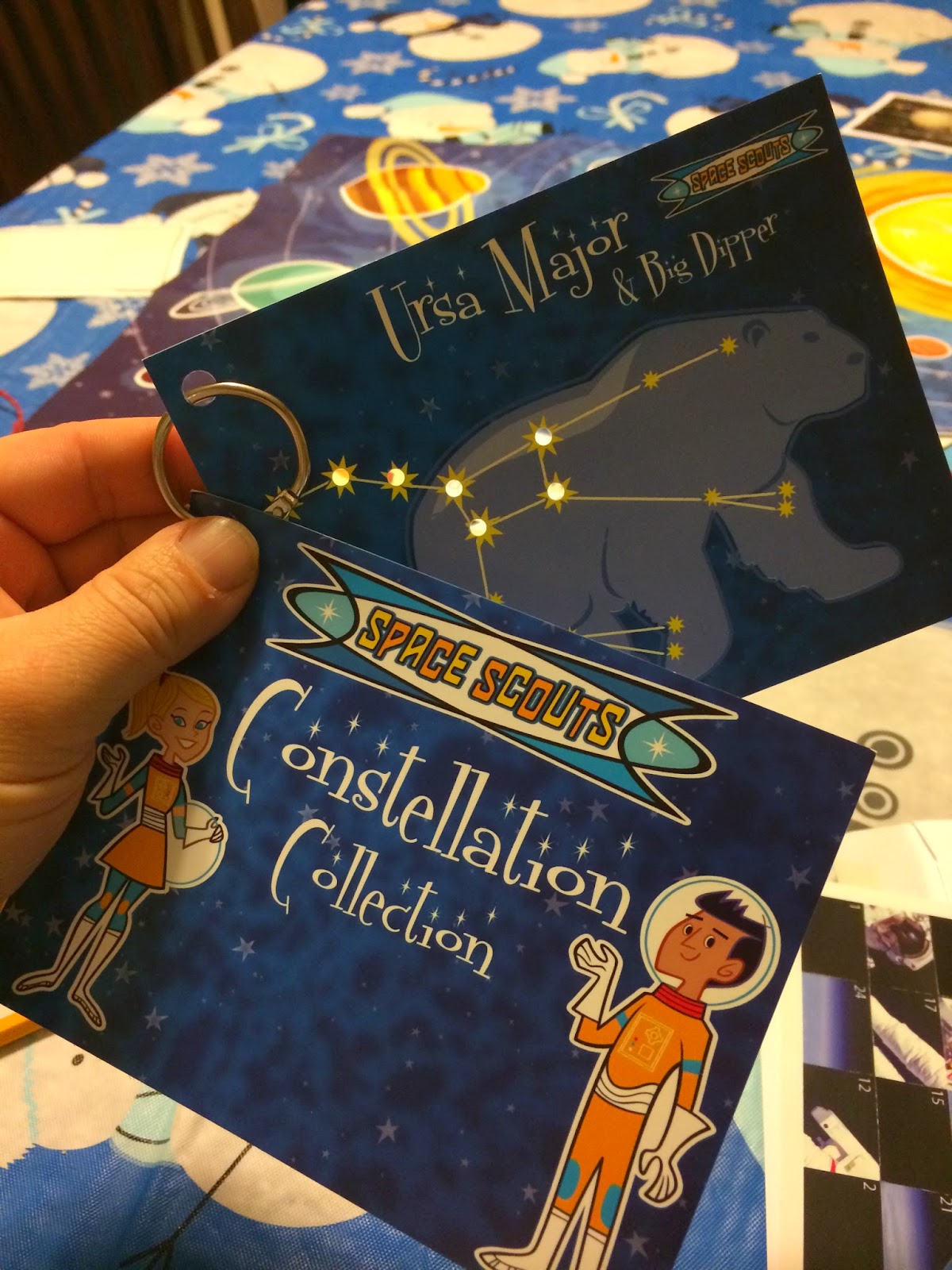
The first month's mailer included a metallic lunchbox (which can be used to store all your Space Scouts stuff), a solar system poster, activity pages, a sticker scramble, a constellation collector ring, and a set of wikki stix that could be used for creative building. We decyphered a code for a secret message, completing a space themed cross word puzzle, and answering astronomy themed trivia questions.
My daughter really enjoyed the sticker scramble where you have to match numbers on sticker sheets to the ones on an index card. If you complete the puzzle correctly you'll see an interesting space image from the unscrambled stickers.
The week two mailer included a grasping hand that amused my son to no end, some astronaut figurines, magnets to place on the Space Scouts lunchbox, a constellation card to include on the storage ring provided in the first mailer. It also included some more activity sheets, another sticker scramble and some stickers to place on the solar system map that was initially provided. Each package provides items that supports and builds upon items previously received to boast children's knowledge of math, technology, science and astronomy.
Pricing starts out at $11.95 + $3 shipping per month with additional
discounted plans for multi-month purchases. A GEEK DADDY blog readers receive a 20% discount on their initial purchase of any SPACE SCOUT subscription plan by using promo code USFAMILY20.
DISCLAIMER: A Geek Daddy Blog was introduced to this product through
its participation in the US FAMILY GUIDE Blogger Program. A Geek Daddy
blog was not provided any financial compensation for this post but was provided a complimentary two month subscription to the Space
Scouts to review. A positive review is not required of our blog to
participate in this promotion. The opinions in this review are my own.